Make Meetings Work for You: Our Proven Process

Whether you love them or dread them, meetings are a part of any business. As I’ve worked with all kinds of companies, I’ve found that most people are usually in one of two groups. The first group has a meeting for anything and everything. They spend more time talking about things than actually doing them. And while the 30 minute meeting starts off discussing marketing plans, an hour later the team is talking about what color to paint someone’s kitchen. The second group never has any meetings at all, leaving projects undone and everyone feeling frustrated with the lack of communication.

Successful businesses know how to avoid both of these extremes. Making meetings work for your business is as simple as using the right process. Here are our tips for setting up a meeting for success from start to finish.

Before Scheduling a Meeting

Much of a meetings’ effectiveness is determined before anyone is in the room. Set your meeting up for success right from the start. Here are a few questions to consider as you are preparing for a meeting:

1. Do we really need a meeting?

Can we accomplish this without scheduling a meeting? Would an email, phone call or even a quick chat in person get us the information we need? If so, skip the meeting. Some meetings do need to happen.

I do recommend that every business has a regular team meeting at least every two weeks. I meet with my team weekly to review projects and sales goals. This way no one falls behind on projects, we keep our sales goals in check and no client gets lost between the cracks.

2. Who needs to be there?

Everyone does not need to be at every meeting. This is especially true if you have a large organization. Consider what needs to be accomplished, who can provide the information needed or offer insight and ideas. You also want to make sure that key decision makers are there so the objective of the meeting can be met right then and not be stalled or left open ended.

3. Do you have an agenda?

Agendas are essential to any successful meeting. Following an agenda will keep everyone on track, make the most of the scheduled time and ensure that you are accomplishing the meeting goals.

We use a digital agenda template saved in Google Drive for our team meetings. Using a template keeps us organized and we don’t have to rethink the meeting topics and objectives each week. Templates can include regular agenda topics as well as an area for special items that might change from meeting to meeting. Agenda topics can also include the estimated time allotted to help keep the meeting from running long.

Make sure you share the agenda with meeting attendees in advance. This gives everyone time to review and prepare. Using a digital agenda also allows everyone to add notes, questions or other relevant information directly to the agenda.

4. What is the meeting objective?

Make sure everyone knows the purpose of the meeting by sharing a clear and concise objective. This will help you keep the meeting focused on the right things. Defining the meeting objective can also helps:

  • Determine who to invite
  • Team members prepare
  • Keep the meeting on topic

5. How can you help your team prepare?

We’ve talked a lot about what needs to happen before you conduct any meeting. And while most of the prep work for a meeting is done by the facilitator, there are ways for meeting attendees to be prepared as well.

  • Review the agenda. Make sure you know what the meeting objective is and be prepared with any information or ideas to contribute.
  • Review the notes from the prior meeting paying special attention to any action items assigned to you or your team. Be prepared to give a status update on tasks and projects.
  • Consider why you were invited. If you will be needed to provide information such as sales numbers or  marketing campaign results, make sure you have the most current and complete information so the right decisions can be made.
  • Know the meeting objective. Consider ways you and your team can help meet that objective.

During the Meeting

Now that you have everyone together, make sure your meetings are productive and positive.

Be a Good Facilitator

Effective meetings need a strong facilitator. The main responsibility of the facilitator is to keep the meeting on track and on time by following the agenda. One tip I always recommend is that the meeting facilitator should be the last person to speak after asking for suggestions. If we are brainstorming new topics and ideas, and I share my ideas first, it’s easy for everyone to say “Oh yeah, good idea! Let’s go with that.” If you wait to let everyone else share first, you’ll end up with a variety of responses and more out of the box ideas.

Assign a Note Taker 

Without a designated note taker, everyone has pieces of the meeting notes, but no one has the full picture. The note taker keeps a record of the discussion, paying special attention to action items and decisions.

The note taker also helps keep the meeting on topic. As other ideas or issues come up that don’t support the meeting objective they can be placed in the “parking lot” and addressed at another time. The note taker keeps track of parking lot items by adding them to future meeting agendas or sending them to the appropriate person or team.

The note taker can also record meeting notes right on the digital agenda. This saves time and work, and all of the meeting notes, decisions and action items will be in a central, available location.

Be a Good Attendee 

It goes without saying that meetings are more productive when everyone there is respectful of the facilitator and other attendees. Know when to listen and when to share.

Don’t be afraid to speak up. If you’ve done your homework and are prepared to contribute you can offer a real perspective and bring value to the meeting.

And while it may be tempting to zone out during parts of the meeting that may not apply to you or your team, pay attention anyway. Offer your outside perspective. For example, someone might be discussing marketing and you’re not in the marketing department. You can still share valuable insights about how the proposed marketing will affect your area, what you’ve seen in your area, and how that relates to the marketing ideas being discussed.  Don’t forget, there is always something more to learn by listening.

Take Your Own Notes

Take your own notes and jot down ideas that come up as the meeting progresses. Make special note of any assignments and keep a running list of action items for you and your team. Highlight or put a star next to anything that pertains specifically to you or your team. This helps you quickly see the items that need to be added to your task list and team follow up.

After the Meeting

You might be tempted to leave a meeting and get back to your other tasks. But the real measure of a successful meeting is determined by what happens afterwards. An effective meeting process will not only include how to prepare and run a meeting, but also help walk you through what needs to follow after the meeting. Here’s a quick checklist to help you follow up:

Follow Up for Facilitators

  • Look through your notes. Add any action items immediately to your CRM or task management software. Don’t forget to assign due dates.
  • Make sure parking lot items are assigned to the next meeting agenda or sent to the right person to follow up.
  • Send out a meeting summary. This could be as simple as sharing the digital agenda so everyone can see the notes and action items. Or you can email a short paragraph summarizing the decisions made and actions that need to be taken. Make sure that everyone is on the same page and can move forward.

Follow Up for Attendees

  • Report back to your team with decisions that impact them
  • Follow up on action items and be prepared to give a status update at the next meeting
  • Check tasks in CRM and make sure you are getting them done

Don’t waste another minute in long, unproductive meetings. Having a process in place for before, during and after a meeting ensures that your meetings work for you. Your team will leave with the information and direction they need to keep your business moving forward smoothly and successfully.


Do you Know Your Peak Time?

As a busy business owner, it feels like I’m constantly trying to juggle all of the demands on my time. In addition to running my business and meeting the needs of my clients, my attention is also shared with my family, community involvement and just trying to keep up my personal sanity! There never seems to be enough time to do everything I wish I could do.

After taking some time off recently, and dealing with the resulting feeling of needing to catch up on everything, I’ve realized that I need to change my perspective about time. Instead of viewing time as an enemy that I constantly need to juggle, I want to see time as a resource I can use and nurture. I need to get caught up and in control of how I use my time. One of the ways I’m choosing to do this is to find and make the most of my peak time.

Peak time is the small window of time during your day when you are naturally more focused, more motivated and able to bust out your to do list. Peak time is when you are most productive. In fact, you can accomplish 80% of the work you need to do using just 20% of the time if you are maximizing your peak time.

Are you a morning person? Or do you do your best work late at night? Maybe you are most productive after lunch. It’s interesting to note that what you think is your peak time may not be accurate at all. To apply the 80/20 rule to making the most of your time, you need to find your individual peak time.

Learn about my action plan for finding and maximizing my peak time with these 3 tips:

3 Ways to Find Your Peak Time

  1. Less Doing Peak Time is a free and fun app that helps you find your peak time.
  2. Are you a Lark, and Owl or a Third Bird? Learn more here.
  3. Record It. Use tracking software to see how long it takes you to complete tasks. Try a browser blocker like Stay Focused, or simply take notes on how you feel at certain times of the day.

Creating processes is still one of my top productivity tips. Once you know your peak time, make the most of it by following established processes that maximize productivity.

To see how your processes are working, take our free 5 Minute Business Check Up here.

For more process tips check out our Process Rehab Facebook group and join the conversation.

I’m curious to know, what’s your peak time?


Tips for Curating a Consistent Theme Across Social Platforms

In today’s digital age, having a strong and cohesive brand presence across social media platforms is essential for businesses and individuals alike. A consistent theme not only helps to establish brand recognition but also builds trust with your audience. To ensure your social media profiles are cohesive and visually appealing, here are some tips for curating a consistent theme across all platforms.

Tips for Curating a Consistent Theme Across Social Platforms

  1. Choose a Color Palette: Select a color palette that reflects your brand identity and use these colors consistently across all your social media profiles. This will help create a sense of unity and cohesion, making your brand instantly recognizable.
  2. Use Consistent Visuals: Whether it’s photos, graphics, or videos, make sure to use consistent visuals that align with your brand’s aesthetic. This could be a specific style of photography, filters, or design elements that tie everything together.
  3. Maintain a Similar Tone: Establish a consistent tone of voice in your captions and posts. Whether your brand’s voice is playful, professional, or informative, make sure it remains consistent across all platforms. This will help in building a strong brand identity.
  4. Create a Content Calendar: Planning and scheduling your social media content in advance can help maintain consistency. Use a content calendar to organize your posts, ensuring that they align with your brand’s theme and messaging.
  5. Engage with Your Audience: Consistency goes beyond just visuals and tone – it also involves engaging with your audience regularly. Respond to comments, messages, and mentions in a timely manner to build relationships and foster loyalty with your followers.

By following these tips, you can curate a consistent theme across all your social media platforms, ultimately helping to strengthen your brand identity and connect with your audience on a deeper level.

USA VPN Business

The major aim of a lot of VPN users all over the world is majorly to tunnel into the USA via the provision of a US IP address. This is simply because the United States is the source of the globe’s most prominent entertainment.

Meanwhile, citizens of the USA need VPNs. It does not matter if it is being used in unblocking contents or enhancing privacy. However, the desires of VPN users may differ from place to place.

First, What Is A VPN?

The VPN is the short form of Virtual Private Network. Interestingly, the VPN manages to encrypt every bit of a device’s web traffic and routes it via a third party server in whichever location the user selects.

So many VPNs are available in the USA. However, some of the best will be addressed in this article.

Some Of The Best VPNs

The Americans making use of VPN services desire ultimate protection and reduced access to foreign contents.

Some of the best VPNs available follow some criteria such as;

  • Powerful codes which are 128-bit AES or more powerful
  • The shared IP addresses are utilized to protect users anonymity
  • The provider is actually not based in the USA
  • Traffic logs are not stored on the servers of the providers
  • There are bonus points for the anonymous payment means like bitcoin

The best VPNs include;

  • Express VPN

It makes use of AES 256-bit code with the prominent open VPN protocol. There are no traffic logs stored showing contents of users? activity. However, metadata is documented.

Express VPN is situated in the British Virgin Islands, and it is way beyond the jurisdiction of the government of USA.

Every one of the servers makes use of shared IP addresses. Basically, a user shares the same IP address with about hundreds of other users worldwide.

Advantages Of Express VPN

The advantages include;

  • It is ideal at unblocking the most prominent streaming sites from practically anywhere
  • It has roughly one thousand swift servers that function across ninety countries
  • It provides powerful information safety plus security
  • Its encryption makes for sturdy security as well as privacy

Disadvantages Of Express VPN

Its disadvantages include;

  • It is expensive, and so more affordable options are available to users

Nevertheless, Payment is accepted in Bitcoin plus PayPal and credit card. Its applications are available for Mac OS, iOS Linux, Android, windows and some specific routers.

  • Nord VPN

This is a VPN provider based in Panama. It has a notable reputation for protection. This includes double hop servers that actually route users? traffic via two VPNs as well as a Tor over VPN alternative.

The Tor VPN alternative transfers traffic using the Tor network when exiting the server. Majority of the IPs are divided while some of the dedicated IP servers are available whenever it is needed.

It makes use of the 256-bit encryption standard. Basically, Nord VPN approves of Bitcoin as a means of payment, and it is rated as one of the ideal values any VPN providers has to offer.

Advantages Of The Nord VPN

Some of its advantages include;

  • It offers a protected, coded connection that has powerful safety and privacy features
  • It simply unblocks a vast range of geo-locked sites
  • It provides around the clock live chat

Disadvantages Of The Nord VPN

Its disadvantages include;

  • Some of its servers can be volatile when it comes down to speed and connectivity

With American citizens straight up in the sight line of diverse intelligence agencies such as NSA and FBI, the citizens fall directly under the jurisdiction of their authority, and users in foreign countries actually have a legal border between themselves.

Issues With Businesses That Are For Sale

The process of beginning a new business is stressful and includes so much work especially if you have never tried it out before.

There will be moments of feeling bad when you realize you are spending so much money and even time trying to develop a thing that is already in existence.

Your main tasks will now entail making something that is highly better and of much quality than what your existing competition has.

However, there is always the option of buying the existing competition. This comprises what we know as a business for sale.

Buying a business is carried out to supplement your already existing business or to function in addition to the current brand you have.

All these are fantastic ways to create and ultimately expand your business empire. The solo entrepreneurs can make this happen as simply as a brand such as Facebook can earn other businesses to merge into its vast conglomeration seamlessly.

Issues With Businesses That Are For Sale

While it is simple to waltz into a business marketplace wherein entrepreneurs are trading off businesses they are no longer interested in, there is actually an issue with this plan.

Majority of the time, these businesses do not work. They are really terrible, and this is because when an entrepreneur puts up his or her business for sale, specifically in a prominent marketplace, there is usually a reason behind it all.

Basically, the general reason is that the business is crashing. It could be that the product is no longer vital or an even stronger competitor may have supplanted it.

So, it could as well be a product or even service that was created poorly, and its inferior quality is steadily catching up to the business.

Nevertheless, it could also be a brand that is greatly reliant on a trend that is temporary and currently fading.

While not all Businesses that are for sale crash, there are times the owner actually has a good reason why he or she wants to step back.

A reason could be medical problems, new family member, or a significant life transformation such as retirement or simply just a change of heart towards the business.

Purchasing a Business That Is not for Sale

It is not so complex purchasing a business that has not been listed for sale. The simple strategy involved is to give the owners an offer too juicy to turn down.

However, this does not mean you should turn into a Godfather to them. You can easily act like Amazon that made an offer to purchase Whole Foods which was not up for sale at the time.

Also, Web analytics company Crazy Egg also pulled a big offer to purchase Hello Bar. Of course, Hello Bar was not for sale either.

In considering such big moves, you should, first of all, think about what the target company is worth to its owner. Calculated his or her cash flow and also estimate the reasonable offers you can see on a marketplace.

The estimate should be stable alongside the amount you are actually willing to spend on purchasing the business. Draft a pitch and send an email.

To Wrap It Up

While businesses for sale is an excellent approach in owning a business, you should always take note and ask questions on why exactly the business is up for sale. No one should hurriedly invest in a business they have no idea why they crashed.

The Amazon Business Model

The world of electronic commerce or e-commerce as it is popularly called has been growing continuously.

This is due to the fact that so many consumers choose to purchase their goods online from the comfort of their homes than was present at the marketplace.

Be it small or large; most companies have gone further to accept the intriguing pros of merging brick and mortar locations as well as supplemental storefronts based on the internet to meet the satisfaction of most of their customers.

Meanwhile, e-commerce mega Giants like Amazon are recognized players in the market. This is because they function via an online presence alone.

Basically, Amazon is a tremendously huge retailer for not only new but used goods as well. However, before going further into Amazon’s business, we should be what a business model is.

What Exactly Is A Business Model?

The business model is a critical element of a company interested in thriving for an extended period of time.

In most cases, the only thing that differentiates a failing business from a successful one aside for the services and products they provide is simply how their value gets unlocked. Business models are the major drivers of value.

The Amazon Business Model

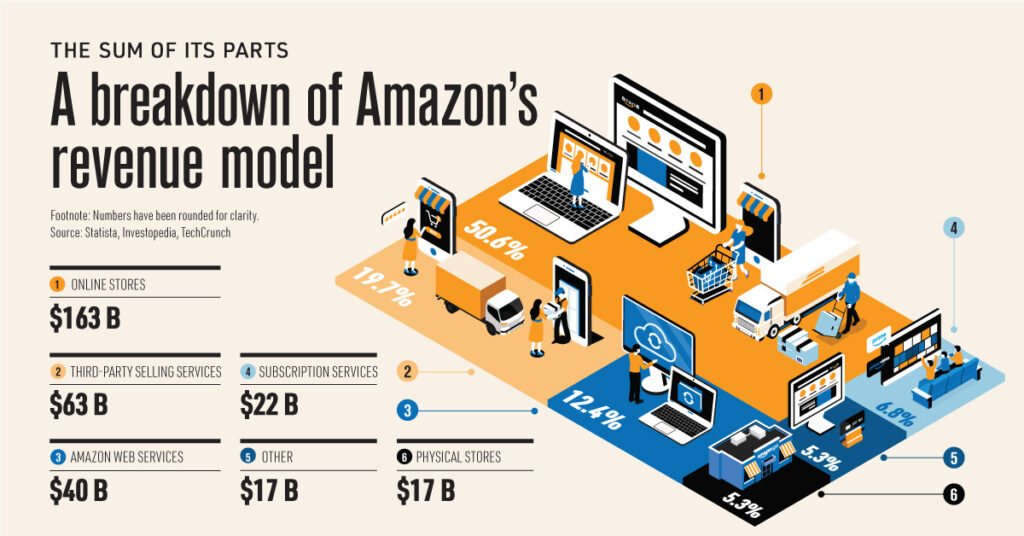
While people rate them as the biggest online retailer in the globe, Amazon practically operates a business model that has diverse parts which are actually more.

Meanwhile, from advertising, prime, AWS and cash machine, Amazon has actually created a highly diversified business model.

While the company trades goods directly, a percentage of its products are provided to buyers via its online storefront. Its inventory is placed in its massive network of warehouses.

Majority of Amazon’s consumers visit their website in assumptions that the products available there are easily affordable and available for buying and shipping.

Additionally, for its direct sales, Amazon offers a platform for retailers to trade their products to prospective buyers.

The products that are sold via the company?s partner retailers are frequently items that are not common or even those with an increased purchase price.

With this, Amazon avoids holding back inventory that is moving slowly and a likely dilute the profit.

Also, fees for retailer partners to lose their items up for sale are not assessed by Amazon. However, Amazon only retains a part of the sales price. This is their commission.

There is a subscription business model maintained by Amazon via its Amazon Prime service. Added to it is a little product line for electronics.

With a prime account, the Amazon customers pay a yearly fee to protect free same day or two-day shipping on items that are eligible for such a purchase.

Furthermore, the customers have free access to streaming media like computerized movies or digit music.

The company also provides profit from trading its e-reader; Kindle. It also sells the e-book and mobile app purchases that are provided for Kindle owners.

To Wrap It Up

Amazon is a huge technological giant that was established as far back as the 1990s. It actually started as a bookstore online. However, it currently sells everything imaginable.

Nevertheless, Amazon is compelling because of its business model which produces value for diverse players.

On Amazon, consumers can discover products at a reduced price and get it delivered swiftly. The sellers can decide to find market opportunities or choose not to carry out further inventory.